Small garden ideas: making the most of a compact space
A small garden is not a problem to solve. It is a space with its own advantages — it is quicker to look after, cheaper to keep tidy, and easier to use every day than a large garden that always seems to need something doing to it. The trick is to plan it as one space, rather than trying to fit a large garden's worth of features into a small one, and to choose surfaces that work hard for the space they take up.
Most small gardens in Wigan are the same shape: a back garden behind a terraced or semi-detached house, a front garden that is mostly path and a strip of planting, and not much room to waste. This guide covers how to make the most of that space — with artificial grass, paving and fencing used together — so a compact garden feels bigger than it is, stays tidy with little effort, and gets used properly rather than just looked at through the window.
It builds on our front garden ideas: grass, paving and fencing together, which looks at the front of the house. This one is for the back garden, where the family actually spends its time — and where a small space has to do the most work.
Start by measuring, not by shopping
The most common mistake with a small garden is to start by choosing things, and only afterwards to discover they do not fit. A table that looked right in the shop is too big for the patio. A lawn that was meant to run the length of the garden leaves no room to walk past it. A fence that was meant to add privacy cuts the light out of the whole garden. Each of these is easy to avoid, and each of them starts with a tape measure.
Measure the garden before you choose anything, and draw it out — on paper, or on a phone, it does not need to be neat. Mark the width and the length, the position of the back door, the windows that look onto the garden, and anything that cannot move: a drain, a manhole cover, a tree, a shed. Then mark where the sun falls, morning and afternoon, because a small garden's sunny corner is its most valuable spot, and it is worth knowing where it is before you decide what goes there.
Once the garden is measured, decide what it has to do. A garden for a family with young children has to do different work from a garden for someone who wants somewhere quiet to sit in the evening. A garden that is mainly for eating outside needs a patio big enough for a table and chairs, with room to pull the chairs out. A garden that is mainly for children needs open ground they can play on, and nothing in the way. Write the list down, in order of importance, and let it decide what gets the space. If the list is longer than the garden, something has to go — and it is better to decide that on paper than after the work is done.
One surface that does the work
In a small garden, every square metre has to earn its place, and the surfaces are where that starts. A garden that is half lawn, half patio, with a path between them and a border down each side, ends up with four small spaces, none of them big enough to use properly. A garden that commits to one main surface, with the rest kept simple, feels larger and works better.
Artificial grass suits a small garden for the same reason it suits a family garden: it stays green and tidy without mowing, it does not turn to mud in winter, and it can be used all year round. In a compact space that matters more, because there is no spare ground to rest a worn patch, and a muddy lawn in a small garden is muddy everywhere. A lawn that is always ready to use means the garden is always ready to use — and in a small garden, that is the difference between a garden that gets used and one that gets looked at.
Our guide to artificial grass for children: play areas that stay tidy covers what to check when children will be playing on the grass, and our guide to artificial grass for dogs: what to know covers pets. Both apply in a small garden, where children and dogs use the same ground as everyone else, and where there is no separate patch for them to wear out.
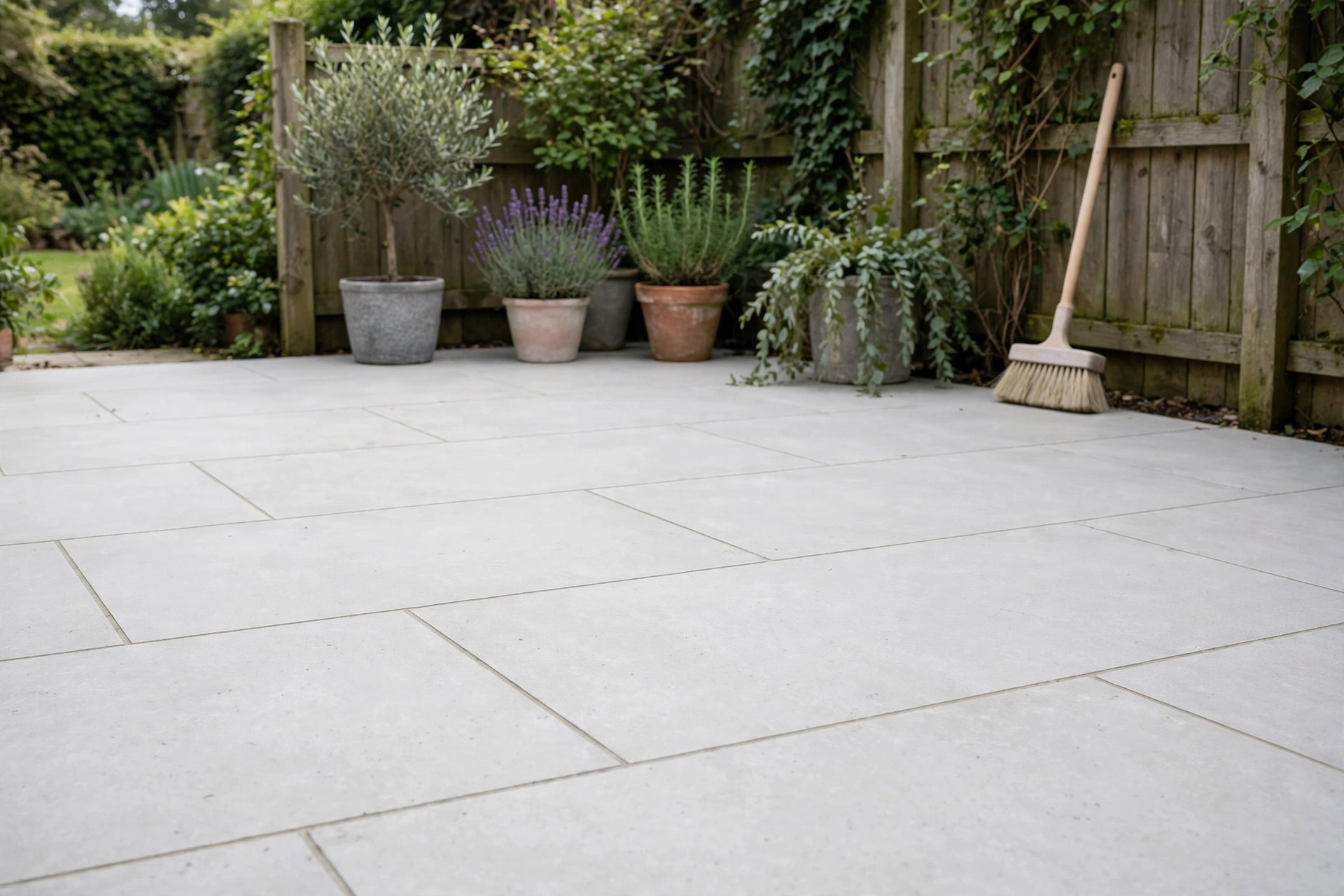
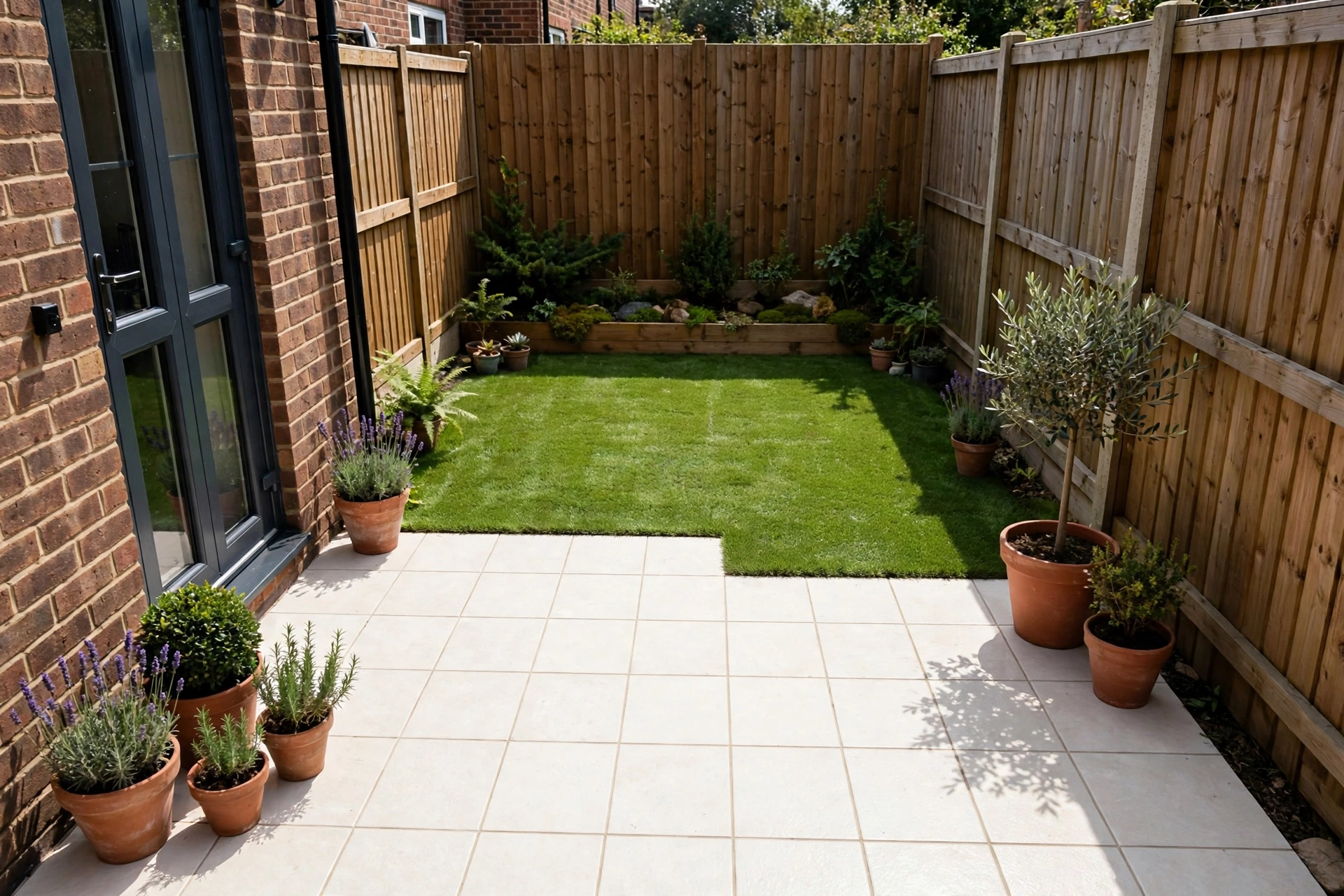
Paving has its place too, and in a small garden it is usually the place where people sit. A small porcelain patio, big enough for a table and two or four chairs, with room to pull the chairs out and walk around them, is enough. It does not need to be large — it needs to be the right size for the furniture that will sit on it, and it needs to be in the sunny part of the garden, not tucked into the shade. Our introduction to porcelain paving in the North West: what to know explains the material, and our guide to porcelain paving vs natural stone: which suits you? will help you choose between them.
The point is not to choose grass or paving and ignore the other. It is to give each one a clear job, and to keep the boundary between them simple. A lawn for playing and walking on, a patio for sitting and eating on, and a clean edge between them — that is a small garden that works. A garden with a little bit of everything, and no clear place for anything, is a garden that feels smaller than it is.
Fencing that adds space instead of taking it
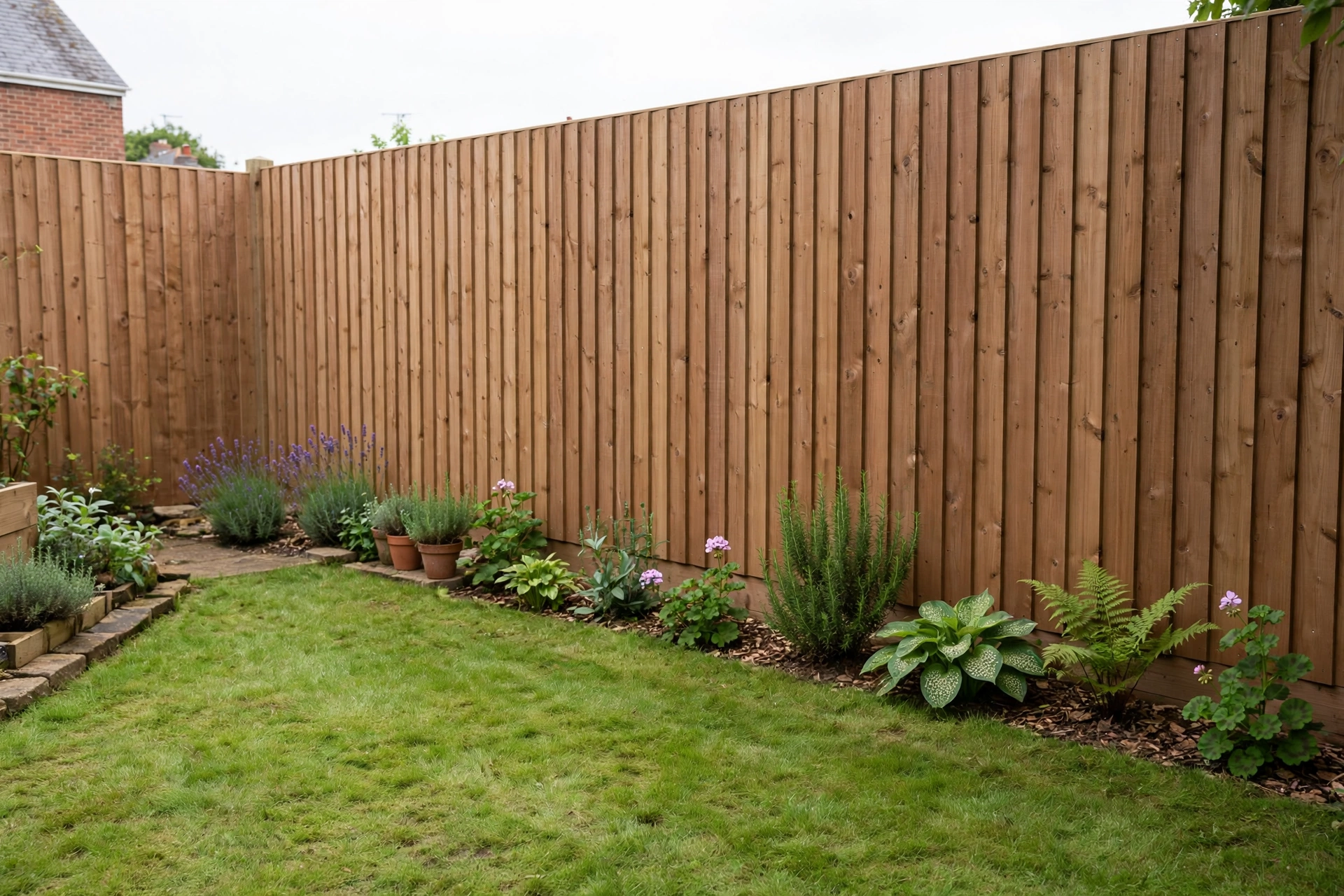
Fencing does more than mark a boundary in a small garden. It is the wall of the room, and it sets how big that room feels. A fence that is too tall, too dark or too close will make a small garden feel smaller. A fence that is chosen with the size of the garden in mind will do the opposite — it will make the garden feel private without making it feel shut in.
Height is the first decision, and it is worth thinking about before you choose a style. A fence that is tall enough for privacy at sitting height, but not so tall that it blocks the light, is usually the right answer for a small garden. Our guide to fencing for privacy: what to ask before you choose covers the questions to ask — height, style, gaps and boundaries — and our guide to fencing in Wigan: what makes a fence last covers what keeps a fence standing. Both are worth reading before you decide, because a fence is the hardest thing in a small garden to change once it is up.
Colour matters too. A fence in a light, natural colour will make a small garden feel brighter and larger than the same fence in a dark stain. That is not a small difference in a garden where every bit of light counts. If the fence is already dark, a lighter planting in front of it — or a lighter surface beside it — will balance it out. The aim is not to make the fence disappear, but to stop it from dominating a space that is already small.
Keep the fence clear, as well. A fence with pots, tools and clutter stacked against it loses a foot of garden along its whole length, and in a small garden a foot matters. Keep the edges of the garden clear, and the middle of the garden open, and the whole space will feel larger than it is.
Storage and seating — the two things that eat a small garden
Two things take up more room in a small garden than people expect: storage and seating. Both are necessary, and both need a plan, or they will spread across the garden until there is no garden left.
Storage should have one place, and it should be the least useful part of the garden — the shaded corner, the strip behind the shed, the space beside the back door that is too narrow to sit in. A small shed, a storage box, or a tidy stack against the fence will hold what needs holding, and it will keep the rest of the garden clear. What should not happen is storage spread along the fence in three different places, with a bike here, a mower there and a pile of pots somewhere else. One tidy spot, and the rest of the garden is free.
Seating should be chosen for the garden, not for the shop. A table and chairs that fit the patio, with room to pull the chairs out, are worth more than a larger set that has to be squeezed in. Folding chairs, a bench against the fence, or a small bistro set will seat the people who actually use the garden, without taking up the space that the lawn needs. And seating that can be folded away in winter, when the garden is not being sat in, gives the space back for the months when it is not needed.
A good test is to stand in the garden and look at what is in it. If the first thing you see is storage or furniture, the garden is full of things rather than space. If the first thing you see is grass and light, the garden is working — and the storage and seating are doing their job without taking over.
Planting that suits a small space
Planting in a small garden should be chosen the way everything else is chosen: for the space it has, and the work it has to do. A plant that grows large will outgrow a small garden quickly, and then it has to be cut back, moved or removed — all of which cost more effort than choosing the right plant in the first place.
Choose plants that stay the size you want them to stay. A small shrub that grows to the height of the fence and stops is better than a large one that has to be cut back every year. A climber on the fence gives height and colour without taking up ground space, and it softens the fence at the same time. Pots are useful in a small garden, because they can be moved — a pot that is in the sun in summer can be moved to shelter in winter, and a pot that is in the way can be moved to the side. But pots need watering, and they need somewhere to stand that is not the middle of the lawn, so keep them to the edges, where they frame the garden rather than fill it.
Keep the planting simple. A small garden with three or four kinds of plant, repeated, looks tidier and larger than a small garden with twenty different plants, each in a different place. Repetition is what makes a small space feel designed rather than crowded. And leave some of the garden empty. An empty patch of lawn, or an empty stretch of patio, is not wasted space — it is the space that makes the rest of the garden feel open.
Keeping a small garden tidy
A small garden shows mess more than a large one. A few leaves on a large lawn disappear; the same leaves on a small lawn are the first thing you see. That is the disadvantage of a small garden, and it is also its advantage — because a small garden takes less time to tidy than a large one, and a few minutes a week is enough to keep it looking its best.
A sweep of the patio, a clear of the leaves, and a look at the lawn is a few minutes' work in a small garden, and it is worth doing regularly rather than saving it up. Our guide to looking after artificial grass in winter covers the colder months, and our guide to porcelain paving cleaning: how to keep patios looking new covers the patio. Both are short jobs in a small garden, and both keep the surfaces looking as they should.
The rule for a small garden is the same as the rule for any garden: clean little and often, and never let a small job become a big one. A leaf cleared today is a minute's work. A leaf left for a month is a stain. A weed pulled today is a second's work. A weed left for a season is a job. In a small garden, that rule matters more, because there is nowhere for the mess to hide — and because the tidy-up is so quick, there is no reason to leave it.
A simple check before you start
Before you change anything in a small garden, ask five questions. What does this garden have to do, and for whom? Is there one main surface, with a clear job, rather than four small ones? Is the fence adding privacy without taking the light? Is the storage in one place, and the seating the right size for the patio? And is there still empty space — lawn or patio — left over, so the garden feels open?
If the answer to all five is yes, the plan is ready. If the answer to any of them is no, that is the part to fix first — and it is usually the fix that makes the garden feel larger, because a small garden that is planned as one space will always feel bigger than a small garden that is filled with separate pieces.
Everlasting Lawns installs artificial grass, porcelain paving, resin driveways and fencing in Wigan and the North West. Quotes are free fixed written quotes after a site survey. See everlastinglawns.co.uk for more, or read the blog for more guides.