Fencing in Wigan: what makes a fence last, and when to replace it
A fence has a harder life than almost anything else in a garden. It stands in wind and rain all year, its posts sit in wet ground, and it gets no shelter in a storm. In Wigan, where wet winters and strong winds are part of the year, the difference between a fence that lasts and one that starts leaning after a couple of winters is rarely the panels you can see. It is the posts, the ground they sit in, and how the fence was built.
Here is what we tell our own enquirers, whether they need a whole new boundary or just want to know if the fence they have is worth saving.
The posts matter most
Ask any fencer what fails first, and the answer is almost always the posts. Panels can be replaced one at a time. A post that has rotted at ground level, or worked loose in its hole, takes the whole run with it.
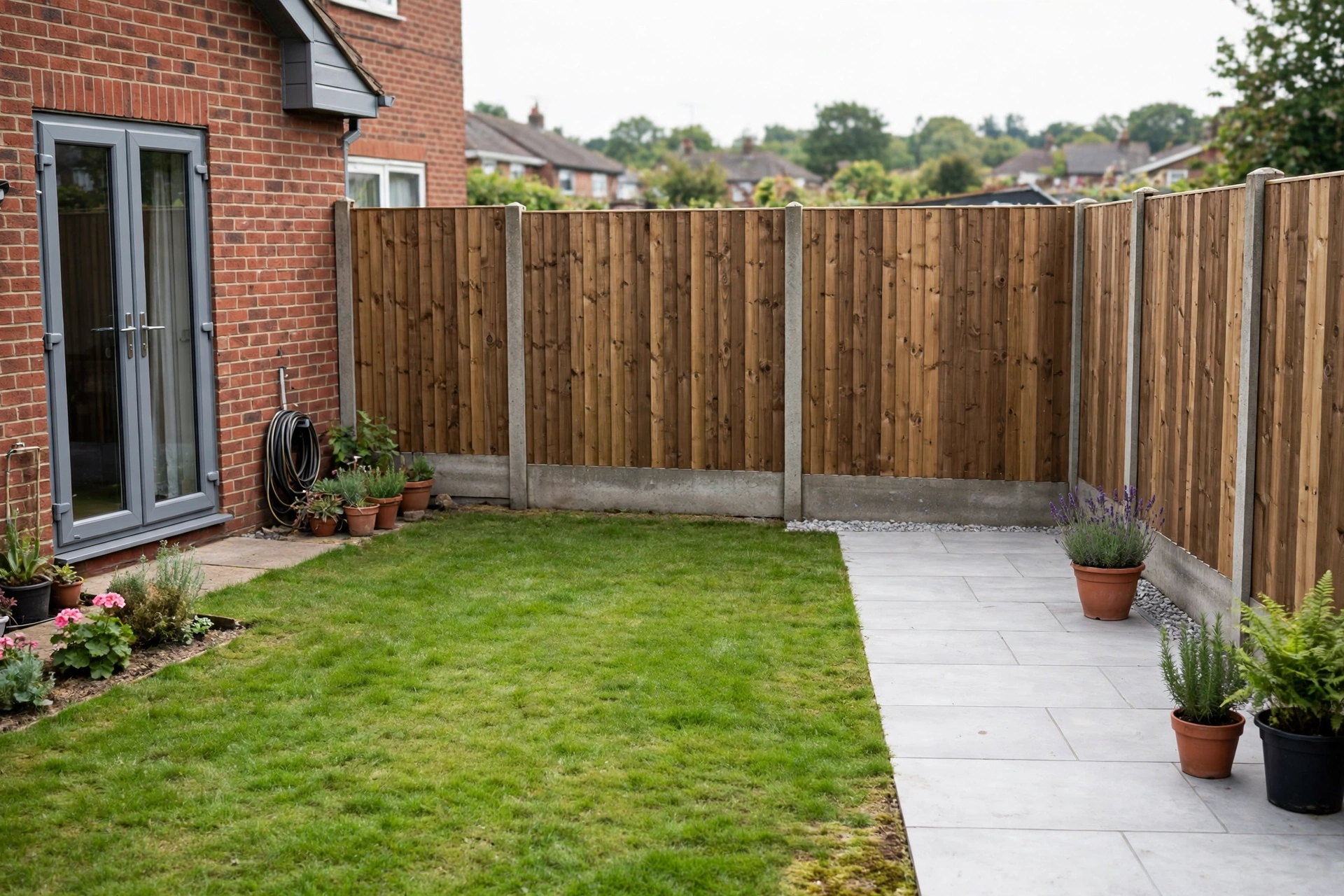
That is why the choice of post, and how it is set, matters more than the choice of panel. Concrete posts last longer than timber posts in wet ground, because they do not rot where they meet the soil. Timber posts can last well too, if they are properly treated and set in concrete rather than just pushed into the earth — but a timber post sitting in wet soil will always be the weak point of the fence.
Whichever you choose, the post should be set in concrete, deep enough to hold against wind, with the concrete finished so water runs away from the post rather than pooling around it. A post that is just backfilled with soil will work loose, and a fence that leans is usually a fence whose posts were never properly set.
Gravel boards — the boards that run along the bottom of the fence, between the posts — are part of the same story. They keep the panels up off the ground, where they would otherwise sit in wet soil and rot from the bottom. A fence without gravel boards will lose its panels from the bottom up, long before the rest of the fence is worn out. Concrete gravel boards last longest; timber ones are fine, provided they are treated and kept clear of soil piling up against them.
Panels: which type, and what to look for
The most common choices in a Wigan garden are close-board (also called featheredge) fencing, lap panels, and composite panels, and each suits a different garden.
Close-board fencing is built board by board onto rails, with the boards overlapping. It is strong in wind, it looks good from both sides, and a single damaged board can be replaced without taking down a whole panel. It is the most durable option for most gardens, and the one we recommend most often for an exposed boundary.
Lap panels are the familiar ready-made panels, with horizontal boards overlapping. They are quicker to put up and usually the most affordable option, but they are weaker in strong wind — the boards can work loose, and a whole panel can blow out in a storm where a close-board fence would hold. They also hide their condition: a lap panel can look fine from the front while the boards behind are already failing.
Composite panels cost more, and they need very little upkeep — no painting, no staining, no rot. They suit a modern garden and a household that does not want to maintain a fence at all. They are heavier than timber, so they need posts and fixings to match, and they are less forgiving if the posts are not properly set.
Whichever type you choose, check the timber itself. Boards should be properly treated, not just stained on the surface, and the rails should be fixed securely to the posts. A panel that rattles in the wind is telling you its fixings are already working loose.
Wind, rain and the ground underneath
Wigan gardens get both: wet ground for much of the year, and strong winds in autumn and winter. A fence has to deal with both at once, and that is where most fences fail.
Wind is the bigger risk. A solid fence acts like a sail, and the taller it is, the more wind it catches. That is why the posts and their concrete footings matter so much — a fence is only as strong as its posts in a storm. A fence that is built in a sheltered garden will last longer than the same fence on an exposed boundary, and that is worth allowing for when you choose the height and the type.
Rain is the slower risk. Water sitting against timber, soil piled up against the bottom boards, and plants growing through the fence all keep the wood wet, and wet wood rots. Keep the base of the fence clear, keep soil and mulch away from the bottom boards, and cut back climbers and shrubs that are holding moisture against it.
Before any fence is built, there are two things to settle that have nothing to do with timber. First, whose boundary is it, and have you agreed the line and the height with your neighbour? A fence built on the wrong line, or to a height your neighbour did not expect, causes far more trouble than any panel choice. Second, check whether there are any local rules that apply — height limits near a road or a pavement, for example, or conditions if you live in a conservation area. A quick check before the work starts is much cheaper than moving a finished fence.
When to repair, and when to replace
Most fences do not need replacing all at once. Here is how to judge it:
Repair it when the problem is in one place — a single panel blown out in a storm, a board that has split, a gate that has dropped on its hinges, or a post that has worked loose but is still sound. A single panel, a new post, or a re-hung gate are straightforward jobs, and they are worth doing promptly: a loose panel left through another winter will damage the posts next to it.
Replace the run when the posts are rotting at ground level, when several posts are leaning, or when panels are failing in several places at once. If you can push a post and feel it move in the ground, or if the base of the post is soft and crumbling when you prod it, the post is finished — and a new panel on a rotting post is money wasted. The same applies if the fence has been patched so many times that no two panels match and the whole run is out of line.
Replace the whole fence when the posts are gone along most of the run, when the fence is leaning along its length, or when the ground itself has changed — a new patio, a raised bed, or a driveway that has altered the levels along the boundary. In that case, starting again properly, with new posts set in concrete and gravel boards to keep the panels off the ground, will cost less over time than patching a fence that has reached the end of its life.
A useful test: stand back and look along the run. A fence that is straight, with panels that sit level and posts that do not move, has life left in it. A fence that waves, leans and rattles is telling you its posts have gone, even if the panels still look presentable.
Gates — the part people forget
A gate is part of the fence, and it fails first more often than the fence itself. A gate hangs on its hinges, so it pulls on one post every time it is opened, and a gate that has dropped will drag, jam and pull its post out of line.
If your gate is dragging, check the hinges and the post before you blame the gate. A gate that is properly hung, on a sound post, with a diagonal brace, should open and close cleanly for years. If the post it hangs from is leaning or rotten, fixing the gate alone will not last — the post needs sorting first.
When a new fence is built, the gate should be built to match it, with the same posts and the same fixings, and with a clear gap underneath so it does not drag on the ground. A gate that is added as an afterthought, on a lighter post, is the part of the fence you will be fixing first.
What to check before you accept a quote
Compare the specification, not just the total — the same advice we give for artificial grass in our guide on what to ask before you accept a quote. For fencing, ask for each of these in writing:
- Post type and how they are set — concrete or timber, set in concrete, and how deep.
- Gravel boards — included or not, and concrete or timber.
- Panel or board type — close-board, lap panel or composite — and the timber treatment.
- Height and length — the full run, measured, including any steps or slopes.
- The gate — included, built to match, and hung on a sound post.
- What happens to the old fence — removal and disposal included or not.
- The boundary — who owns it, and whether the line and height are agreed with your neighbour.
If one quote comes in noticeably below the others, it is almost always down to one of these. Shorter posts, no gravel boards, thinner panels, or a missing gate will not show on the day the fence is finished — they will show in the first strong wind, or the first wet winter.
Not sure whether to repair or replace?
Send us a photo or two of the fence, and a rough length of the run, and we will come out, look at it properly, and give you an honest view — whether a repair will do, or whether a replacement will save you money in the long run. No obligation, and no pressure either way.
We install bespoke fencing, artificial lawns across Wigan, Standish and the North West, porcelain paving and resin bound driveways. Read the full guide on our artificial grass cost page.
Find out what your garden would cost
Rough size and a couple of photos is all we need to get started. Call 07967 293173, email everlastinglawns@icloud.com, or get a free quote — free survey, fixed written price, no obligation. Our office is 85 School Lane, Standish, Wigan WN6 0TE.