Porcelain paving in the North West: what to know before you choose
Porcelain paving has become one of the most asked-for choices for patios in Wigan and across the North West, and it is easy to see why. It looks clean and modern, it stays looking the same year after year, and it asks very little of you once it is down.
It is not the right choice for every garden, though, and the difference between a patio that still looks new in five years and one that starts to cause trouble is rarely the slab itself. It is the thickness, the way it was laid, and whether it suits the spot it is going in.
Here is what we tell our own enquirers before they choose.
What porcelain paving actually is
Porcelain paving slabs are made from clay and minerals fired at a very high temperature, which makes them dense, hard and very low in absorption. That is the property that matters most in the North West.
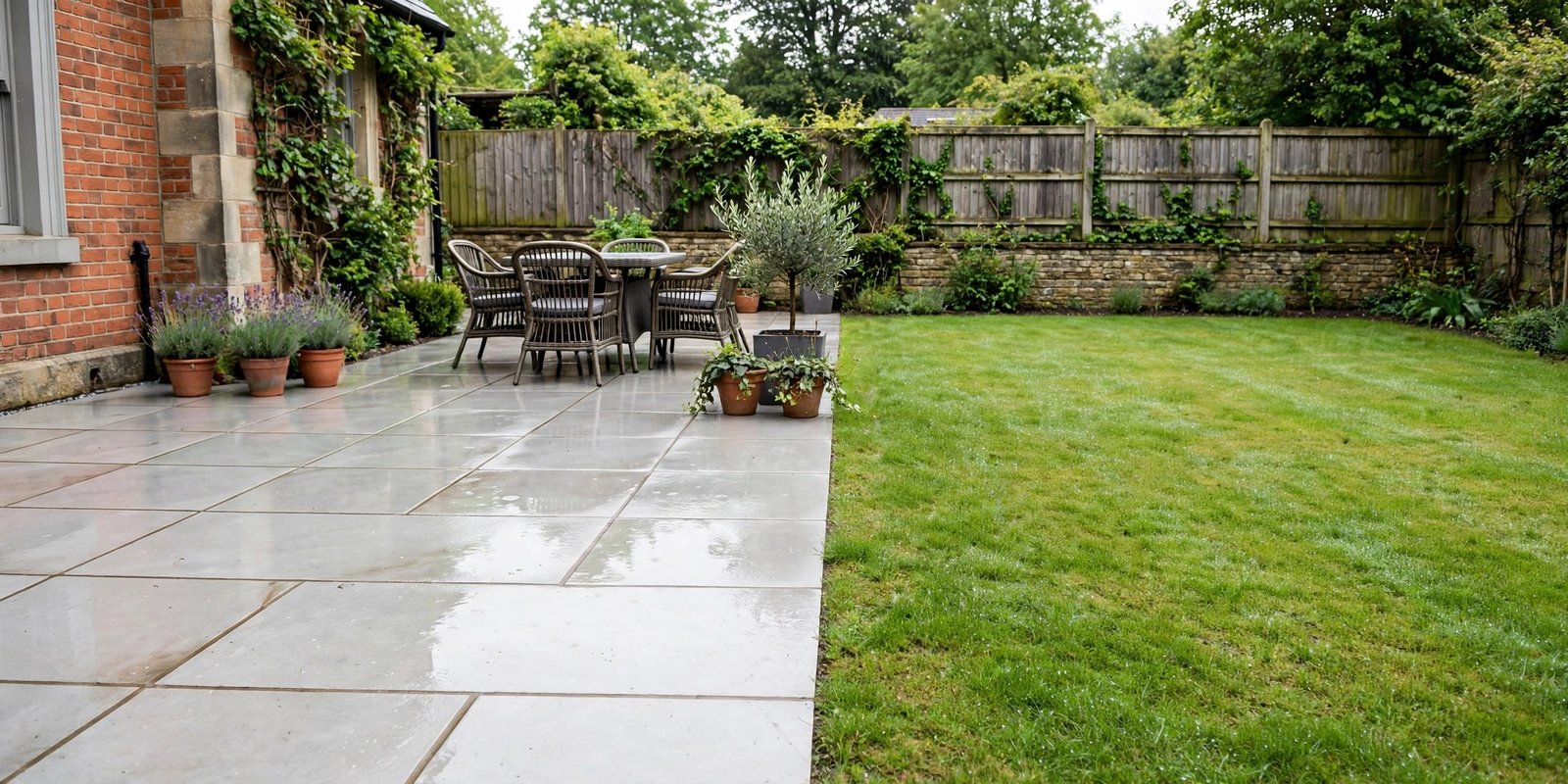
Because they take in so little water, they do not soak up rain the way some natural stone does, they resist algae and staining, and they do not fade in sunlight. A light grey slab looks much the same after a wet winter as it did when it was laid. They are also frost resistant, which matters here — water that gets into a porous stone, freezes and expands is what causes flaking and cracking over winter. Porcelain largely avoids that problem.
They do not need sealing to stay stain resistant, unlike some natural stone. That is one of the reasons people choose them: less upkeep, and no annual sealing job to remember.
What porcelain will not do is look like natural stone up close. The colours and textures are inspired by stone, and good ranges look convincing from a few steps back, but a slab is a manufactured product with a consistent finish. If you want the variation and character of real stone, with its marks and colour changes, porcelain is not the material for that. If you want a clean, even, modern finish that stays the same, it is hard to beat.
Thickness and size — check what you are being quoted
Outdoor porcelain paving is usually 20mm thick. That thickness is part of what makes it suitable for patios and paths, and it is one of the first things to check in a quote: thinner indoor tiles are not the same product, and they do not belong outside.
Slabs are commonly large — the familiar 900 x 600mm size is popular — and large slabs suit a modern patio, with fewer joints and a calmer look. They also show up any unevenness in the laying, so a large-format patio needs a properly prepared, level base more than a small-slab one does.
Ask what thickness and size are in the quote, in writing, and check that the slabs named are outdoor porcelain, not indoor tiles. A quote that just says "porcelain paving" without a thickness or a product name is not specific enough to compare with another quote.
Slip resistance — especially in shade and wet weather
A patio in the North West spends a good part of the year wet, so slip resistance is worth asking about directly. Porcelain slabs are made with different surface finishes, and some are much grippier underfoot than others when wet.
Ask for the slip rating of the slabs being quoted, and think about where the patio sits. A sunny, open patio dries quickly. A shaded patio, one under trees, or steps and a path that stays damp, needs a better grip. This is not a detail to leave until the slabs arrive — by then the choice is already made.
The same applies to colour. Very pale slabs look bright and modern, and they show leaves, mud and algae more readily than a mid-grey. Very dark slabs look striking, and they show dust, pollen and water marks. A mid-tone, lightly textured slab is the most forgiving day to day in a family garden.
How it should be laid — this is where patios fail
This is the part that matters most, and the part that is hardest to judge from a brochure photo. Porcelain slabs should be laid on a full bed of mortar, with the back of each slab primed, and with proper joints and drainage falls built in so water runs off the patio instead of sitting on it.
What you do not want is slabs spotted onto dabs of mortar with gaps underneath. That is the shortcut that leads to rocking slabs, cracked corners and hollow sounds underfoot, usually within a year or two. It is also very hard to fix without lifting the patio and starting again.
So ask, before you accept a quote, what the laying method is: a full mortar bed or not, whether the slabs are primed, what the base underneath is, and how drainage is handled. A good installer will answer those questions plainly. The same principle applies to every surface we lay — as we set out for driveways in our guide to resin vs block paving vs tarmac, what is underneath matters more than what you see on top.
Edging matters too. A patio without a proper edge will spread and settle at the borders, and the outside slabs are always the first to move. Check that edging is in the quote, not left as an afterthought.
Matching the patio to your house and garden
Porcelain suits a modern house, a new extension with large doors, or a garden where the patio runs straight out from the kitchen. The large, even slabs carry the line of the house into the garden, and the same material can run from indoors to outdoors where the levels allow.
For an older cottage or a traditional garden, it can still work, but the finish and the colour need more thought — a warm grey or a stone-effect range will sit more comfortably than a stark white or a polished black. Bring a sample home and look at it against your brickwork and in the actual light of your garden, morning and afternoon, before you decide. A slab that looks perfect in a showroom can look cold or harsh in a north-facing Wigan garden.
Think about how the patio will be used as well. A dining patio needs to be level enough for chairs and a table, with room to pull chairs out. A path to the washing line or the shed just needs to be safe underfoot in the wet. A patio that doubles as a play area needs a surface that is not too slippery when wet and that will not stain if a drink is spilt on it — porcelain is good on both counts.
Cleaning and upkeep
This is the easy part. Porcelain paving needs very little: a sweep, and a wash with water and a mild detergent when it looks grubby. Algae can still grow on the surface in shade, as it can on any paving, but it washes off rather than soaking in.
Do not use harsh chemicals or a pressure washer held too close to the joints — the slabs will take it, but the grout and the pointing may not. A gentle clean, done regularly, keeps a porcelain patio looking new for years.
If a slab does get damaged, it can usually be lifted and replaced on its own, provided the installer left you a spare or two. Ask for spares to be left with you when the job is finished — matching a batch later is never guaranteed.
What to check before you accept a quote
Compare the specification, not just the total — the same advice we give for artificial grass in our guide on what to ask before you accept a quote. For porcelain paving, ask for each of these in writing:
- Slab thickness and size, and the exact product name — outdoor porcelain, not indoor tile.
- The slip rating, and whether the finish suits a shaded or wet spot.
- The laying method — a full mortar bed with primed slabs, not dabs.
- What is underneath — the base, the falls for drainage, and the edging.
- The jointing — what grout or pointing is used, and how wide the joints are.
- Spares — a few extra slabs left with you for future repairs.
If one quote comes in noticeably below the others, it is almost always down to one of these. A thinner slab, a cheaper laying method, or a missing edge will not show on the day the patio is finished — it will show a year later.
Not sure porcelain is right for you?
Porcelain is a strong choice for a modern patio that needs to look good with little upkeep in North West weather. It is less suited if you want the character of natural stone, or if your garden is very traditional and a manufactured finish would look out of place.
Every garden is different — light, drainage, levels and how the space is used all change the answer. Send us rough dimensions and a photo or two, and we will come out, look at the garden properly, and give you an honest view on whether porcelain suits it, with a free fixed written quote if you go ahead. No obligation, and no pressure either way.
We install porcelain paving, artificial lawns across Wigan, Standish and the North West, resin bound driveways and bespoke fencing. Read the full guide on our artificial grass cost page.
Find out what your garden would cost
Rough size and a couple of photos is all we need to get started. Call 07967 293173, email everlastinglawns@icloud.com, or get a free quote — free survey, fixed written price, no obligation. Our office is 85 School Lane, Standish, Wigan WN6 0TE.